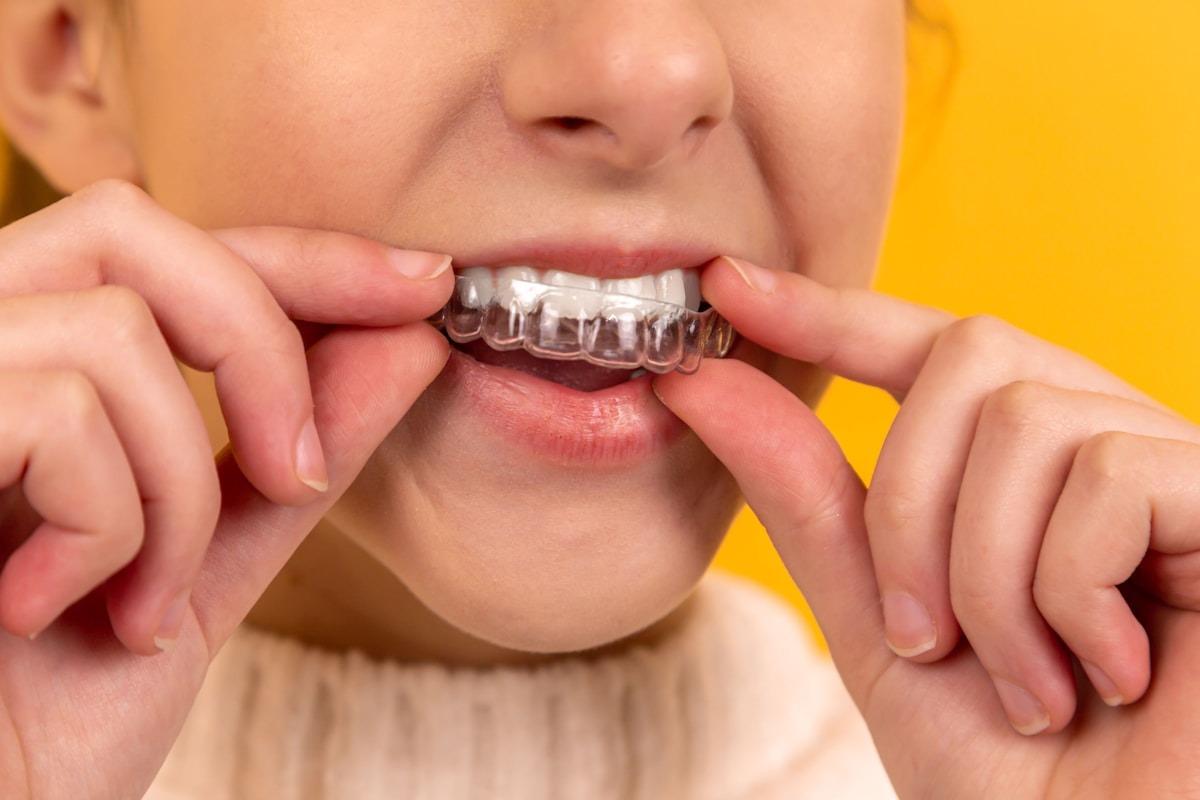
Want a straighter smile without the brackets and wires of traditional braces? Clear aligners offer a discreet and removable way to gradually improve the alignment of your teeth. Each set of aligners is designed to guide specific tooth movements as treatment progresses. The results can be noticeable, but they are not identical for everyone. The amount of correction depends on the starting position of the teeth, the type of movement needed and how consistently the aligners are worn. Understanding these factors can help you have realistic expectations about your treatment.
Quick Answer
Yes, clear aligners can effectively straighten teeth in many suitable cases. They can improve several common alignment concerns, although more complex movements may require additional treatment or a different orthodontic approach.
How Do Clear Aligners Actually Straighten Teeth?
Clear aligners are custom-made removable trays designed to guide teeth through a planned sequence of positions.
Rather than moving every tooth at once, each aligner is designed to make specific movements. As you progress through the planned series, your teeth gradually move toward their intended positions.
Some patients may also need small tooth-coloured attachments. These are placed on selected teeth to provide additional control for particular movements.
The treatment is therefore not simply about wearing transparent trays. The plan needs to consider:
A professional assessment before treatment helps determine whether the planned movements can realistically be achieved with clear aligners.
What Results Can You Realistically Expect From Clear Aligners?
Clear aligners can improve tooth alignment and the appearance of your smile when the required movements are suitable for this type of treatment.
Depending on your individual case, treatment may help with:
- Certain types of dental crowding
- Selected spaces between teeth
- Some rotated or misaligned teeth
- Certain bite-related alignment problems
- Uneven dental arch appearance
- Positioning of selected front teeth
The amount of improvement depends on how your teeth are positioned before treatment and what needs to change.
For example, someone with mild spacing may have a different treatment pathway from someone with significant crowding or a more complicated bite.
It is also important not to judge your expected result by looking at someone else's before-and-after photograph. Two people can have similar-looking concerns but require very different tooth movements.
Your treatment plan should be based on your own teeth, bite and treatment goals.
How Much Can Your Teeth Actually Move With Clear Aligners?
Clear aligners can produce noticeable changes, but not every type of tooth movement is equally predictable.
Some movements are relatively straightforward, while others require greater control. More challenging movements can include certain rotations, changes in tooth angulation, intrusion and complex three-dimensional positioning.
This is why a clear aligner treatment plan may include additional techniques or appliances when necessary. Depending on the case, treatment may involve:
The goal is not simply to move the teeth as much as possible. The aim is to achieve the planned tooth positions while also considering the bite, supporting tissues and overall dental health.
How Can Clear Aligners Change Your Smile? Before and After
Before-and-after photographs can help demonstrate the types of changes orthodontic treatment may produce, but they should not be treated as a prediction of your individual result.
Depending on your starting condition, you may notice:
- Straighter front teeth
- Less visible crowding
- Reduced or closed spaces
- Improved alignment of individual teeth
- A more even-looking dental arch
- Changes in how certain teeth meet
The visible improvement depends on what needs to be corrected.
Someone with mild spacing, for example, may have a very different treatment journey from someone with significant crowding or complex tooth positioning.
This is why your expected outcome should be discussed based on your own dental condition rather than compared directly with photographs found online.
Who Can Get Good Results from Clear Aligners?
Clear aligners may provide predictable results when the required tooth movements can be appropriately managed with removable trays.
They are commonly considered for selected cases involving:
- Mild-to-moderate alignment problems
- Certain types of crowding
- Selected spacing problems
- Some appropriate bite corrections
- Patients who can follow the required wearing schedule
More complicated cases may present additional challenges. Severe malocclusions, impacted teeth, significant skeletal discrepancies and some complex tooth movements may require a different treatment approach or additional orthodontic techniques.
Your oral health also matters. Existing tooth decay, gum problems or other dental conditions may need attention before orthodontic treatment begins.
The important question is therefore not simply “Can clear aligners straighten teeth?”
It is:
“Can clear aligners predictably achieve the movements my teeth require?”
That is what an individual assessment is designed to determine.
How Long Does It Take to See Results With Clear Aligners?
Clear aligner treatment does not follow the same timeline for everyone. Some patients may begin noticing visible changes as treatment progresses, while achieving the planned final result can take several months.
For some straightforward alignment concerns, treatment may take around 6 months. More involved cases may take 12–18 months or longer.
The actual timeline can be influenced by:
- The starting position of your teeth
- The amount of movement required
- The complexity of your bite
- How consistently you wear your aligners
- Whether attachments are needed
- Whether additional aligners or refinements are required
- How your teeth respond to the planned movements
- Whether adjustments are needed during follow-up
A shorter treatment time does not automatically mean a better result. The more important consideration is whether the required movements can be completed appropriately and whether the final alignment can be maintained.
When Might Clear Aligners Not Give the Expected Result?
Clear aligners can produce good results in many appropriately selected cases, but some tooth movements are more difficult to control than others.
Results may be less predictable when treatment involves:
- More severe tooth or bite problems
- Significant jaw or skeletal discrepancies
- Impacted teeth
- Certain extraction-based cases
- Difficult tooth rotations
- Complex changes in tooth angulation or position
- Movements requiring a high level of control
This does not necessarily mean clear aligners cannot be used in a complicated case. It means the treatment plan needs to account for the movements that actually need to be achieved.
In some situations, braces or a combination of orthodontic approaches may provide greater control.
The goal should therefore be choosing the treatment approach that can best achieve the required result, rather than choosing aligners only because they are removable or less noticeable.
Consistent wear matters because aligners work by applying planned forces over time. Frequently leaving them out for long periods can interfere with the planned sequence of tooth movement and may extend treatment.
If you cannot wear your aligners for the prescribed amount of time, avoid changing your treatment schedule on your own. Discuss the situation with your treating dental professional.
What If Your Teeth Do Not Move as Planned?
Sometimes a tooth may not track exactly as expected during clear aligner treatment.
You may notice that:
- An aligner does not fit as closely as it previously did
- A gap appears between the aligner and a tooth
- A particular tooth seems to be lagging behind
- The next aligner feels unusually tight or does not seat properly
- Your teeth do not appear to be progressing as expected
This does not necessarily mean that the entire treatment has failed.
Your dental professional can assess the fit and determine whether you should continue with the current aligner, make an adjustment or use additional aligners.
What Are Refinement Aligners?
Refinement aligners are additional trays used when further tooth movement is needed after the original sequence.
They may be considered when:
- A tooth has not moved as planned
- Additional alignment is required
- Small spaces remain
- The bite needs further adjustment
- The final result needs fine-tuning
Refinements are not necessarily a sign that treatment has gone wrong. Tooth movement can require adjustments as treatment progresses, which is why follow-up assessment is an important part of achieving the intended result.
Will You Need Attachments or IPR With Clear Aligners?
Clear aligners do not always work by using the trays alone.
What Are Clear Aligner Attachments?
Attachments are small tooth-coloured shapes placed on selected teeth. They provide additional surfaces for the aligner to grip and can help guide particular movements more effectively.
They may be used when a specific movement is difficult to achieve with a smooth aligner surface alone.
Because they are generally small and tooth-coloured, they may not be very noticeable during everyday conversations.
What Is IPR (Interproximal Reduction)?
IPR stands for interproximal reduction.
It involves carefully removing a very small amount of enamel from selected areas between teeth to create space for planned tooth movement.
IPR is not required for every clear aligner patient. When it is considered appropriate, it can be part of creating enough space for the planned alignment.
- Why additional space is needed
- Which teeth may be involved
- How much enamel is planned to be reduced
- How the procedure fits into your overall treatment
Attachments and IPR should therefore be discussed as part of the treatment plan rather than being unexpected steps during treatment.
What Does Clear Aligner Treatment Feel Like?
Clear aligners gradually move your teeth into their planned positions, so it is normal to notice mild pressure, tightness, or soreness, especially during the first few days of wearing a new set of aligners.
You may experience:
- Mild pressure around certain teeth
- Temporary tooth tenderness
- A feeling of tightness when inserting a new aligner
- Mild irritation along the edges of the aligner
- A temporary change in speech or pronunciation
A slight lisp or change in pronunciation may occur when you first start wearing clear aligners. Most people gradually adapt as they become accustomed to having the aligners in their mouth.
The level of discomfort can vary from person to person and may also differ at different stages of treatment. If discomfort is severe, persistent, or accompanied by significant irritation, it is advisable to consult your dentist or orthodontist.
Can You Eat or Drink While Wearing Clear Aligners?
Clear aligners should generally be removed before eating. This helps protect the trays and makes it easier to maintain good oral hygiene.
When your aligners are in place, plain water is the safest routine drink.
Hot drinks should be avoided while wearing the trays because heat may affect the aligner material. Sugary drinks can also create a problem because sugars may remain around the teeth when the aligners are put back in.
After eating:
Maintaining this routine can help protect your teeth while you work toward your planned alignment result.
Clear Aligners vs Braces: Which Can Give Better Results?
There is no single option that produces the best result for every patient.
Clear aligners can be attractive because they are:
- Less noticeable
- Removable
- Convenient for eating and brushing
- Suitable for many selected alignment problems
Braces can provide greater control for certain tooth movements and more complex orthodontic problems.
The important difference is not simply aligners versus braces. It is whether the selected appliance can achieve the movements your teeth actually require.
For example, a patient with straightforward crowding may be suitable for clear aligners, while another patient with a complex bite or difficult tooth movement may benefit from braces or another treatment approach.
If your priority is a predictable result, the treatment should be selected according to your dental condition rather than appearance alone.
What Happens to Your Results After Clear Aligner Treatment?
Finishing your final aligner does not necessarily mean your treatment is completely finished.
Teeth can gradually shift after orthodontic treatment. This is why retention is an important part of maintaining the alignment you achieved.
A retainer helps hold the teeth in their corrected positions while the surrounding tissues adapt to the new tooth positions.
Depending on your treatment plan, retainers may be removable, fixed or a combination of both.
How Long Do You Need to Wear Retainers?
Retention is generally a long-term commitment. Many patients are advised to continue wearing removable retainers at night for the long term, sometimes indefinitely, to reduce the risk of unwanted tooth movement.
The exact wearing schedule can change over time and should follow your treating professional's instructions.
An important expectation to understand before starting clear aligner treatment is:
Straightening your teeth is one stage. Maintaining the result is another.
Is It Safe to Use Clear Aligners Without Seeing a Dentist?
Clear aligners may look simple because they are removable plastic trays, but the treatment involves controlled tooth movement. Starting treatment without an appropriate dental assessment can mean that important factors are missed, including:
- Your existing bite
- The condition of your teeth and gums
- The amount of space available
- The type of tooth movement required
- Existing dental problems
- Whether aligners are suitable for your case
- Whether the planned movements are progressing correctly
Online photographs or automated treatment plans cannot replace an appropriate clinical assessment when treatment decisions depend on the condition and movement of individual teeth.
Professional monitoring is also important during treatment. If a tooth is not tracking properly or an aligner stops fitting as expected, the treatment plan may need to be reviewed.
For this reason, clear aligner treatment should not be approached as simply ordering trays and wearing them without professional supervision.
What Happens During Your First Clear Aligner Consultation?
The first consultation is mainly about determining whether clear aligners are appropriate for your teeth and what kind of result can realistically be planned. The assessment may include:
Depending on your case, diagnostic records may also be required to help with treatment planning. A useful consultation should give you a clearer understanding of what needs to change, how those changes may be achieved, how long treatment may take and what you should expect after treatment.
Instead of asking only about the price, you can also ask:
- What results are realistic for my teeth?
- Which teeth need to move?
- How long is treatment likely to take?
- Will I need attachments or IPR?
- How many hours should I wear the aligners?
- Could refinements be required?
- What happens if a tooth does not move as planned?
- How long will I need retainers?
These questions can help you understand the treatment and set realistic expectations before starting.
About Dr. Jessica Yolanda Jeevitha
Dr. Jessica Yolanda Jeevitha, BDS, Master’s in Oral and Maxillofacial Surgery, has a professional background in oral and maxillofacial surgery and dental rehabilitation. Her background includes experience in dental rehabilitation and oral healthcare, with treatment planning based on each patient's individual dental needs at Supreme Elite Clinic.
Why Consider Supreme Elite Clinic for Clear Aligner Treatment?
Choosing a clinic for clear aligner treatment should involve more than comparing the appearance of aligners or treatment prices.
Patients can consider whether the clinic provides:
- A proper assessment before treatment
- Clear explanation of the expected tooth movements
- Individualised treatment planning
- Progress monitoring
- Guidance when an aligner does not fit properly
- Discussion of attachments, IPR or refinements when applicable
- A clear retention plan after treatment
For patients considering clear aligner treatment in Padur or Kelambakkam, an initial consultation can help determine whether this treatment approach is appropriate for their individual needs.
The goal should be a treatment plan that matches the required tooth movement and the patient's desired outcome—not simply choosing aligners because they are less visible.
How Can You Get Started With Clear Aligner Treatment?
If you are considering clear aligners, begin with a professional assessment rather than choosing treatment based only on online photographs or promotional claims. During your consultation, discuss:
- Whether you are a suitable candidate
- What changes are realistically expected
- How long treatment may take
- Your required daily wear time
- Whether attachments or IPR may be needed
- Whether refinements may be required
- How progress will be monitored
- What type of retainer you may need
- How your result will be maintained after treatment
Having these points explained before treatment begins can help you make a more informed decision.
Conclusion
So, can clear aligners really straighten your teeth?
Yes. Clear aligners can produce meaningful improvements in tooth alignment for many appropriately selected patients.
But the final result depends on more than the aligners themselves. The complexity of your case, treatment planning, consistent wear, attachments or IPR when required, follow-up care, refinements and long-term retention can all influence the outcome.
If you are considering clear aligners, focus on the result you want and whether the treatment plan can realistically achieve it—not simply on how invisible the appliance looks.
Frequently Asked Questions
Book a Clear Aligner Assessment
Consult Dr. Jessica Yolanda Jeevitha and our specialist dental team at Supreme Elite Clinic, Kelambakkam & Padur, OMR Chennai.
Book Consultation Now